.svg)
.svg)
.svg)
SOX Compliance 2025: A Modern Guide for Businesses
Learn how SOX compliance strengthens financial controls. Explore sox risk assessment, 404 testing, and audit readiness for accurate reporting in 2025.
Accorp Compliance Team
Our team of compliance experts specializes in PCI DSS, SOC 2, and other security frameworks to help businesses achieve and maintain compliance.
The Sarbanes-Oxley Act of 2002 (SOX) was enacted to restore investor confidence after accounting scandals involving companies like Enron and WorldCom. For businesses navigating complex financial reporting landscapes—especially those preparing for an IPO or audit—understanding modern SOX compliance requirements is critical.
This guide breaks down the key components of SOX, including Section 404, SOX risk assessment, internal controls, and testing methodologies, to ensure your business stays compliant and audit-ready in 2025.
What Is SOX Compliance?
SOX compliance refers to adhering to regulations that ensure the reliability and integrity of corporate financial reporting. Although SOX is a U.S. law, it impacts any public business—foreign or domestic—that files financial statements with the SEC.
Core goals of SOX include:
Improving financial transparency
Strengthening internal controls over financial reporting (ICFR)
Enforcing executive accountability
Protecting whistleblowers
Reducing fraud risk
SOX is enforced by the SEC and monitored through independent audits overseen by the Public Company Accounting Oversight Board (PCAOB).
Key SOX Compliance Requirements
Section 302: Corporate Responsibility
Section 302 holds CEOs and CFOs accountable for financial statement accuracy. They must:
Certify the effectiveness of internal controls
Disclose any fraud or control weaknesses
Sign off on quarterly and annual reports
Non-compliance can lead to fines up to $5 million or imprisonment for up to 20 years.
Section 404: Internal Control Assessment
The most intensive area of SOX, Section 404, requires both:
Management to assess internal controls
Independent auditors to attest to these assessments
This process is known as the SOX 404 assessment, central to establishing SOX 404 internal audit readiness.
SOX 404 Risk Assessment: The Foundation of Compliance
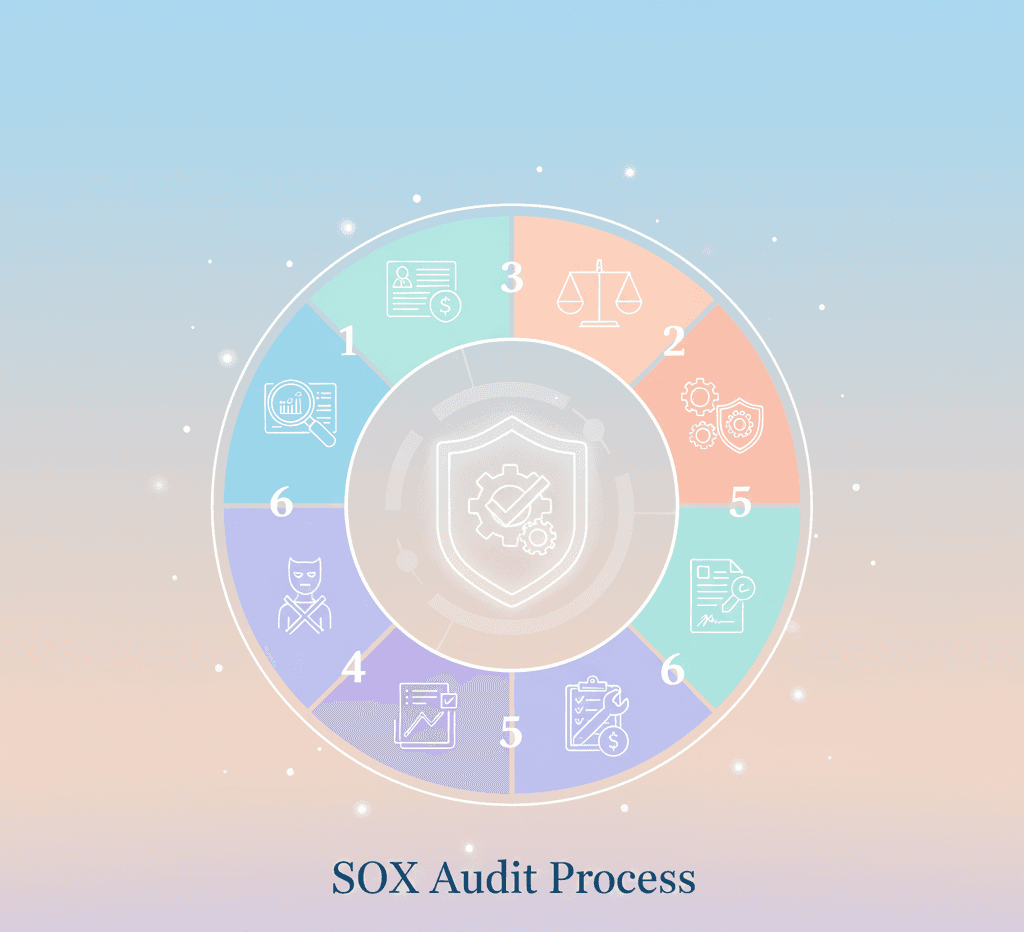
A robust SOX 404 risk assessment is vital for establishing effective controls. Here's how to approach it:
1. Determine Scope
Identify material accounts and disclosures that could impact financial reporting. These often include revenue recognition, financial assets, or IT security.
2. Identify Key Controls
Map processes relevant to material accounts and define key controls. Common types include:
Entity-level controls (e.g., governance, ethics)
IT General Controls (ITGCs)
Application controls (e.g., automated approval processes)
3. Evaluate Fraud Risk
SOX demands assessment of fraud risks, especially management override. Mitigating controls often include:
Whistleblower policies
Segregation of duties
Dual approvals for journal entries
4. Test Control Design and Effectiveness
Testing includes:
Design effectiveness: Does the control mitigate risk adequately?
Operational effectiveness: Is the control working consistently?
Methods include walkthroughs, inspections, re-performance, and inquiry.
5. Document and Remediate
Categorise deficiencies as:
Control deficiency
Significant deficiency
Material weakness (requires public disclosure)
Proper documentation and remediation are essential to meet SOX 404 requirements and avoid audit issues.
Why SOX Compliance Matters
Beyond compliance, implementing SOX can drive business value through:
Improved financial accuracy and reduced error rates
Enhanced investor confidence
Stronger cyber-defence through IT control alignment with NIST or Model Audit Rule compliance frameworks
Better governance and ethical accountability
Common SOX Challenges and Solutions
Many organisations still rely on spreadsheets to manage SOX 404 internal audit controls. Challenges include:
Version control issues
Inconsistent documentation
Trouble tracking deficiencies and remediation
Solution: Leverage SOX automation platforms that provide:
Centralised control documentation
Structured workflows
Real-time dashboards
Scalable test and report capabilities
Best Practices for SOX Compliance
Start early—build a year-round SOX strategy
Collaborate across Finance, IT, HR, and Audit teams
Document everything in clear, auditable formats
Prioritise high-risk areas
Use frameworks like COSO to standardise controls
Conclusion
SOX compliance is not just a legal requirement—it’s a cornerstone of financial transparency and corporate governance. By performing thorough SOX 404 risk assessments, managing SOX 404 internal audits, and leveraging automation tools, your organisation can mitigate risk, satisfy regulators, and foster trust with stakeholders.
Let experts like Accorp support your financial reporting journey with tailored guidance on controls, testing, and automated compliance infrastructure.