.svg)
.svg)
.svg)
Your Roadmap to FedRAMP Cloud Certification: Key Steps and Requirements for CSPs
Your roadmap to FedRAMP cloud certification: key steps, compliance requirements, and assessment essentials every CSP needs for a successful authorisation.
Accorp Compliance Team
Our team of compliance experts specializes in PCI DSS, SOC 2, and other security frameworks to help businesses achieve and maintain compliance.
In today's tech-driven world, it's nearly impossible to read industry news without encountering the cloud—and for good reason. Cloud computing has become foundational to modern IT infrastructure. From rapid provisioning of resources to increased scalability, the cloud empowers organisations to respond faster to shifting demands. As cloud adoption grows, so does the need for robust security and compliance standards, especially in the public sector.
Recognising this, the U.S. federal government implemented the Cloud First mandate, directing federal agencies to adopt cloud-based solutions whenever they are secure, cost-effective, and reliable. This shift demanded a standard framework for securing cloud services, leading to the creation of the Federal Risk and Authorisation Management Program (FedRAMP).
What is FedRAMP Compliance?
FedRAMP is a government-wide program that standardises the approach to security assessment, authorisation, and continuous monitoring for cloud services. It ensures that cloud service providers (CSPs) meet rigorous FedRAMP security compliance requirements before being used by federal agencies.
To be eligible, a commercial cloud service offering (CSO) must undergo a comprehensive FedRAMP assessment and obtain what's called an Authority to Operate (FedRAMP ATO). This confirms that the solution meets the security standards defined by NIST 800-53, tailored by the FedRAMP Program Management Office (PMO).
Key FedRAMP Compliance Requirements
To achieve FedRAMP cloud certification, CSPs must:
Complete detailed documentation, including FedRAMP SSP templates
Prepare a thorough FedRAMP System Security Plan (SSP) using NIST requirements
Categorise their system under the FIPS 199 standards
Be assessed by a Third Party Assessment Organisation (3PAO) via a FedRAMP Security Assessment Plan (SAP)
Address any findings and develop a Plan of Action and Milestones (POA&M)
Obtain a formal FedRAMP ATO
Implement a continuous monitoring (ConMon) plan with monthly vulnerability scans
FedRAMP Authorisation Paths
There are two primary paths to achieving FedRAMP authorisation:
Agency ATO: CSPs partner with a federal agency that sponsors the authorisation. This ATO applies only to that agency, and other agencies must independently evaluate and issue their own ATOs based on their specific risk appetites.
FedRAMP P-ATO: Granted by the FedRAMP Board, this path offers broader reuse potential across multiple federal agencies and streamlines the FedRAMP audit process.
The core principle of FedRAMP is "do once, use many times." Once a CSO receives authorisation, other agencies can leverage the security package, which includes the FedRAMP Security Assessment Report (SAR) and related documentation, to expedite their own ATO decisions.
The FedRAMP Board's Role
The FedRAMP Board is instrumental in streamlining and scaling the authorisation process. It helps coordinate multi-agency authorisations, aiming to reduce redundant assessments and enhance collaboration across departments. The board also oversees the creation of newer, faster paths to FedRAMP cloud certification.
FedRAMP Compliance Process (Step-by-Step)
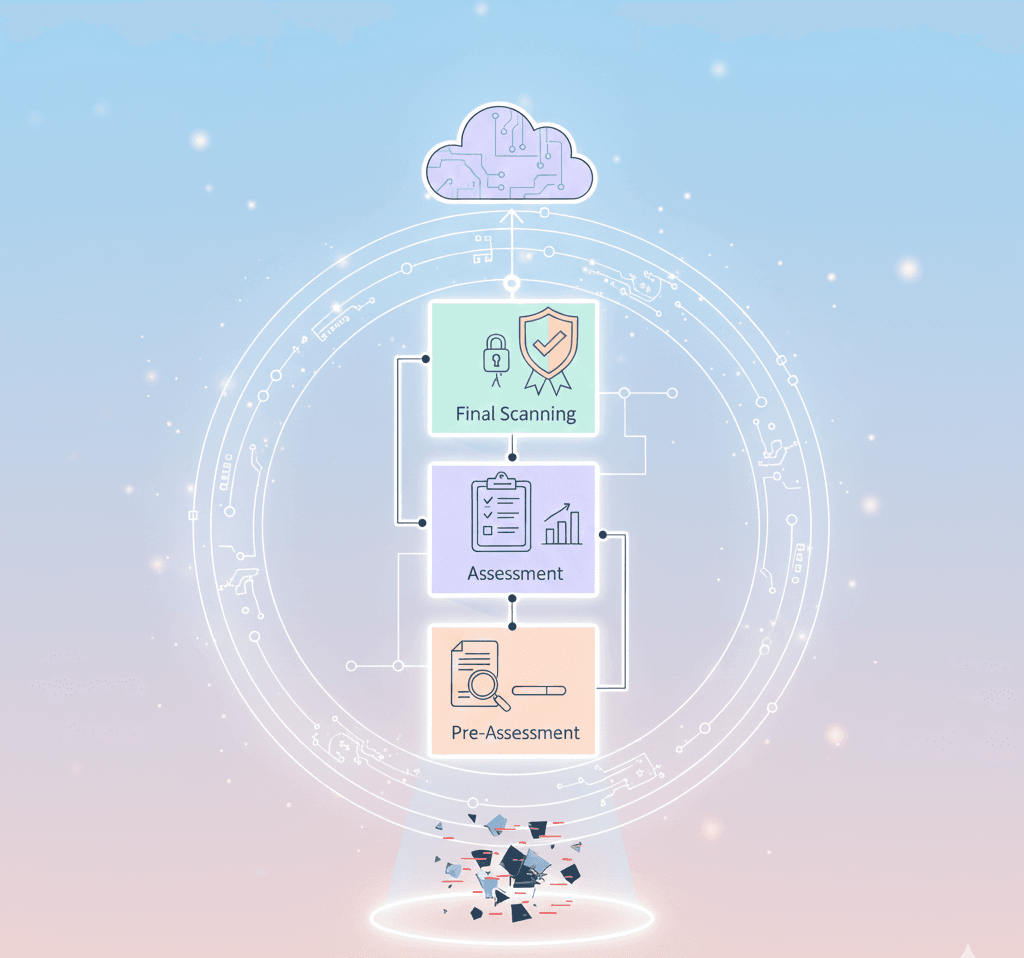
1. Document
CSPs begin by determining the impact level (Low, Moderate, or High) of their CSO based on FIPS-199. They then tailor and complete the FedRAMP System Security Plan (SSP) using official templates. This foundational document outlines how each security control is implemented.
Additional required documents include:
Contingency Plan
Incident Response Plan
Configuration Management Plan
2. Assess
With documentation complete, a 3PAO develops and executes a FedRAMP SAP. This involves hands-on testing of implemented controls on a production-ready system. The results are compiled into the FedRAMP SAR.
3. Authorise
The sponsoring agency or FedRAMP PMO reviews the SAR. Additional testing or documentation may be requested. Upon approval, the CSP receives its FedRAMP ATO.
4. Continuous Monitoring
Once authorised, CSPs must maintain compliance through continuous monitoring. This includes:
Monthly vulnerability scans
Regular updates to the POA&M
Annual 3PAO assessments
Timely submission of compliance data to the authorising agency
Why FedRAMP Matters for CSPs
Achieving FedRAMP cloud certification unlocks access to the federal marketplace. With growing demand for secure cloud services, FedRAMP authorisation positions CSPs to serve a wide range of agencies while demonstrating compliance with high FedRAMP security standards.
To support CSPs earlier in the process, FedRAMP now offers a FedRAMP Readiness Assessment. This includes a FedRAMP Readiness Assessment Report (RAR) to help organisations evaluate their readiness before entering a full assessment engagement.
It is a significant investment, but with the right roadmap and expert guidance, CSPs can successfully navigate the FedRAMP process—from readiness assessments to audits—and realise long-term growth.
Ready to Get Started?
At Accorp, we offer end-to-end FedRAMP advisory, audit, and assessment services tailored to your organisation’s needs. From completing FedRAMP SSP templates to preparing for your FedRAMP audit, we help ensure your cloud service meets all compliance requirements and stands out in the public sector.