.svg)
.svg)
.svg)
NIST Cybersecurity Framework (CSF): A Roadmap for Every Industry
NIST Cybersecurity Framework (CSF): A roadmap for every industry to manage risks, strengthen resilience, and align security with business goals.
Accorp Compliance Team
Our team of compliance experts specializes in PCI DSS, SOC 2, and other security frameworks to help businesses achieve and maintain compliance.
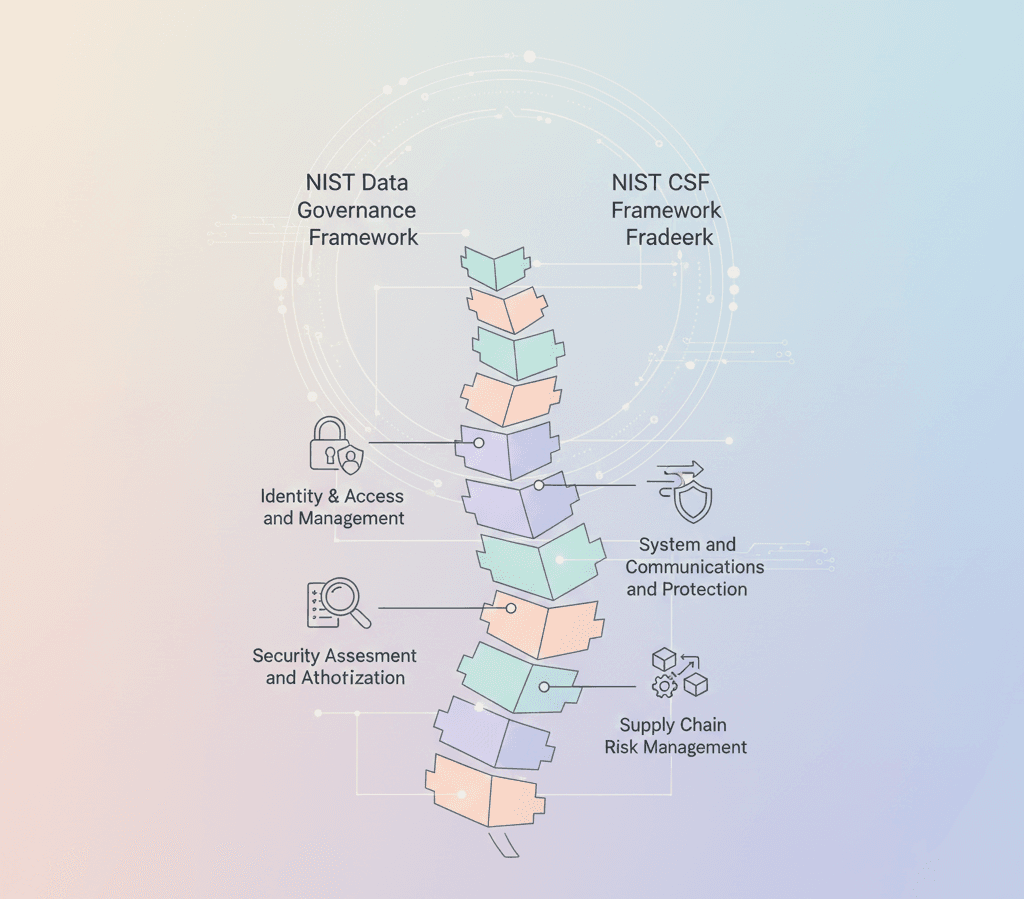
The NIST Cybersecurity Framework (CSF) is an adaptable, industry-neutral model that enables organisations to effectively manage and reduce cybersecurity risks. Unlike more regulatory-focused NIST standards like SP 800-171 or SP 800-53, CSF functions as both a cybersecurity governance framework and a strategic playbook. It supports organisations in aligning cybersecurity controls with overall business goals, while integrating seamlessly with related standards such as the NIST supply chain framework and NIST governance framework.
This makes it especially valuable for companies that require a holistic approach to integrating technical, operational, and NIST supply chain cybersecurity safeguards.
Key Elements of CSF
NIST CSF centres on five core functions—Identify, Protect, Detect, Respond, and Recover—to help organisations prioritise their cybersecurity activities and enhance resilience. These functions can easily support complementary requirements like NIST supply chain risk management and NIST 800 53 supply chain risk management for organisations managing third-party dependencies.
Identify – Discover critical assets, evaluate risks, and align cybersecurity with business priorities using the NIST data governance framework.
Protect – Apply safeguards to ensure services and information remain secure, including controls adopted under the NIST CSF supply chain category.
Detect – Monitor systems and supply chains continuously for anomalies and cybersecurity events.
Respond – Execute strategies to contain threats and minimise the impact of cyber incidents.
Recover – Rebuild operations effectively with enhanced resilience based on insights from the NIST CSF framework.
Why It Matters
Implementing the NIST CSF framework empowers organisations by:
Shifting cybersecurity from a technical obligation to a strategic differentiator—all under a recognised cybersecurity governance framework.
Connecting executive and technical stakeholders through a shared risk-informed language.
Aligning risk mitigation and budget decisions with real-world threats.
Supporting scalability across diverse industries while integrating with NIST supply chain cybersecurity and compliance objectives.
Conclusion
The NIST Cybersecurity Framework is more than a checklist—it is an evolving strategic blueprint for enterprise resilience. Whether you’re building out a robust governance strategy or addressing vulnerabilities across your supply chain, CSF offers a structured way to grow cybersecurity maturity and align it with long-term business impact.