💰
GuideApr 2025 · 8 min read
ESOP Taxation in India — A Complete Breakdown
Understand when tax hits (hint: it's at exercise, not grant), how perquisite value is calculated, and what TDS obligations companies carry.
Read


.svg) +91 9968297717
+91 9968297717.svg) +44 7721 703160
+44 7721 703160.svg) +1 (747) 388-6155
+1 (747) 388-6155From ESOP scheme drafting to exercise compliance, valuation & accounting — handled by Accorp's specialist team. Fixed fees, zero surprises.
Select exactly what you need. Every fee is fixed — no hidden charges, no hourly billing.
Live cost estimate — updates as you select
All fees are fixed — no hidden charges. Government fees billed at actuals separately.
Every milestone — from scheme design to cap-table updates — flows through a single, audit-ready pipeline.
From planning to liquidity — a complete 9-stage process covering Companies Act 2013, Income Tax Act, and SEBI compliance. Typical end-to-end delivery: 6–8 weeks.
Define ESOP objectives, identify eligible employee pool, set option pool size (typically 5–15% of equity), and align with founders on vesting philosophy.
Skipping a written policy on eligibility leads to disputes later.
Prepare the scheme document covering vesting schedule, cliff period, exercise price, exercise window, and exit/leaver clauses — compliant with Section 62(1)(b) and Rule 12 of Companies (Share Capital) Rules, 2014.
Generic templates miss tax-efficient structuring for Indian employees.
Convene a Board Meeting to approve the scheme, then call an EGM/AGM to pass a Special Resolution. Private companies need an Ordinary Resolution; listed and public unlisted need Special Resolution.
Notice period and explanatory statement requirements are often overlooked.
File Form MGT-14 with the Registrar of Companies within 30 days of passing the special resolution, attaching the certified resolution and ESOP scheme.
Late filing attracts additional fees up to 12x the normal rate.
Issue individual grant letters to selected employees specifying number of options, vesting schedule, exercise price, and acceptance terms. Maintain ESOP Register (Form SH-6).
Missing employee acknowledgement creates enforceability gaps.
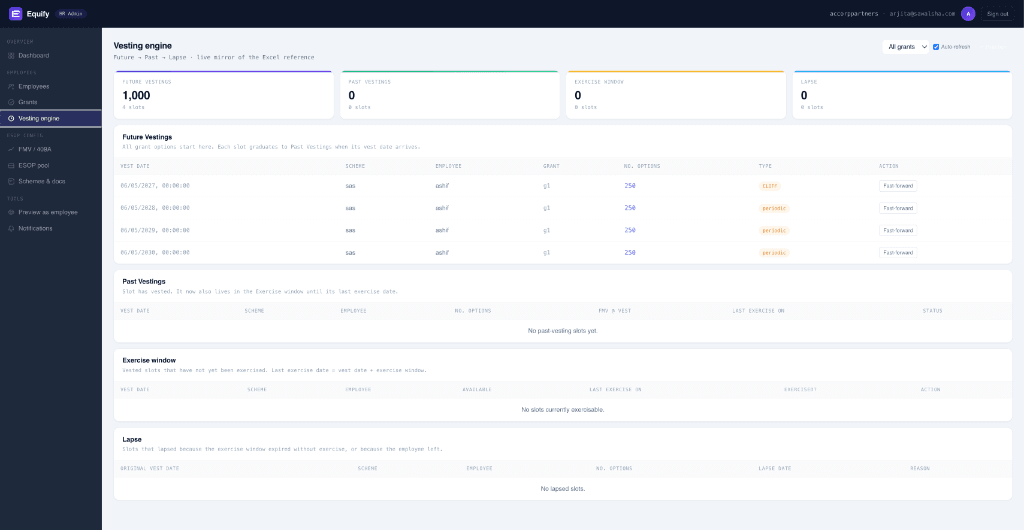
Track vesting milestones, handle leavers (good leaver vs bad leaver clauses), accelerate vesting on liquidity events, and update the ESOP register quarterly.
Manual tracking in spreadsheets fails at scale — invest in cap-table software.
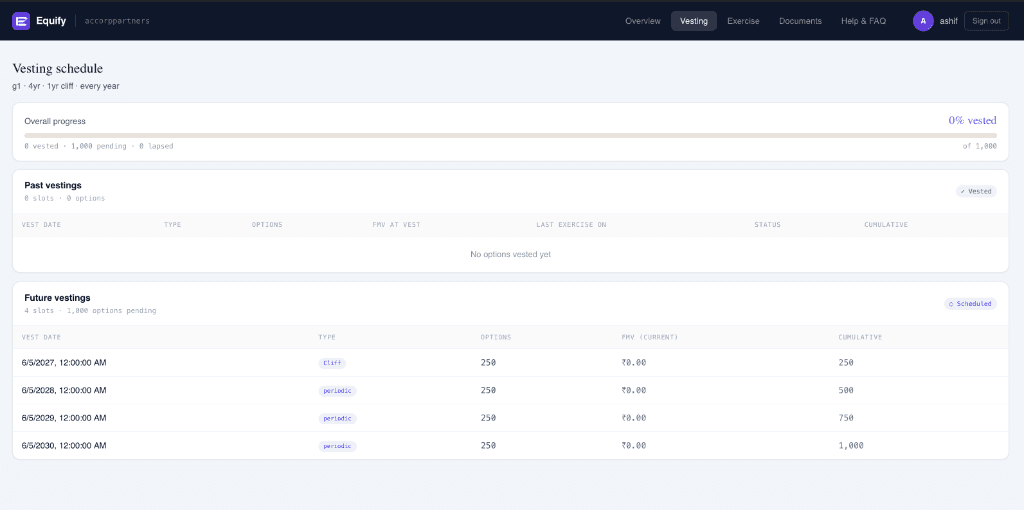
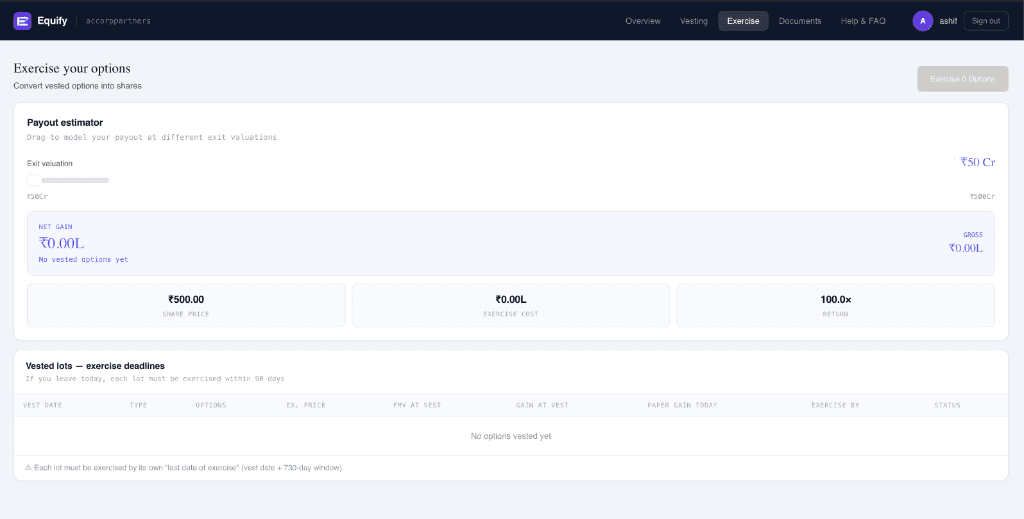
Employee pays exercise price, company allots shares, and files Form PAS-3 within 30 days. Perquisite tax (FMV minus exercise price) is deducted as TDS at exercise.
Forgetting Rule 3(8) FMV valuation by Merchant Banker triggers tax notices.
On sale of shares (buyback, secondary, or IPO), employees pay capital gains tax — short-term or long-term depending on holding period from allotment date.
Employees often don't know cost basis = FMV at exercise, not exercise price.
Disclose ESOP details in the Board's Report annually, maintain SH-6 register, file PAS-3 for each allotment, and reconcile option pool in cap table.
Auditors flag missing disclosures during statutory audit, delaying signoff.
The complete checklist of statutory documents and ROC filings needed to issue ESOPs in India.
Records board approval of the ESOP scheme and grant.
Records shareholder approval passed at the EGM/AGM.
Mandatory shareholder vote authorising the ESOP scheme.
Annual report must include ESOP disclosures per Companies Act.
Statutory register tracking grant, vesting, and exercise events.
Filed with ROC to register the special resolution within 30 days.
Return of allotment filed within 30 days of share allotment.
Signed grant letters issued to each eligible employee.
Practical guides to help you navigate ESOP compliance, taxation, and best practices.
Understand when tax hits (hint: it's at exercise, not grant), how perquisite value is calculated, and what TDS obligations companies carry.
MGT-14, PAS-3, SH-7 — every filing mapped to its deadline with penalty implications for delays.
Why you need a Registered Valuer at grant but a Merchant Banker at exercise, and how each impacts tax treatment.
A clause-by-clause guide to drafting an ESOP scheme that's legally compliant and employee-friendly.
Understand exactly what an ESOP costs your company — before you commit a single rupee. Our free ESOP Cost Calculator is built for Indian founders, CFOs and HR leaders who want a clear, line-item view of everything that goes into running an Employee Stock Option Plan — from the first board resolution to the final exercise event years later.
Instead of vague "starting from" quotes, the tool breaks every ESOP project into the same three phases we follow internally: Scheme Setup, Grant & Allotment, and Exercise & Ongoing Compliance. You pick what your company actually needs and see the total update live.
ESOP scheme document, SHA provisions, board & shareholder resolutions, MGT-14 ROC filing, participation agreement and grant letter templates.
Merchant banker / Cat-I valuation, FMV report under Rule 11UA, grant cycles, board approvals, employee onboarding and SH-6 register updates.
Exercise event handling, perquisite tax computation, TDS via Form 24Q, PAS-3 return of allotment, cap-table updates and annual compliance.
The calculator mirrors the way a real ESOP project is scoped. You move through three phases, toggle the deliverables you need, and the total cost — along with statutory fees and timelines — recalculates instantly. No emails, no sales calls, no hidden line items.
ESOP projects routinely run 2–3× over budget when valuations, ROC fees and grant-cycle work are quoted later. Seeing the full picture up front prevents that.
Investors and acquirers diligence the ESOP trail line by line. A properly costed, properly filed scheme keeps your cap table defensible.
When you know the true cost of running an option pool, you can size it correctly — and explain the dilution math to your board with confidence.
Every ESOP project is scoped differently, but the ranges below give you a realistic starting point before you use the calculator. All figures are professional fees only — GST @ 18% and government fees (ROC, stamp duty, merchant banker signing fees) are charged separately at actuals.
| Deliverable | Typical fee (₹) | Timeline |
|---|---|---|
| ESOP scheme drafting + board / shareholder resolutions | ₹75,000 – ₹1,25,000 | 2–3 weeks |
| MGT-14 filing with ROC | ₹10,000 – ₹15,000 | 1 week |
| Cat-I merchant banker valuation (Rule 11UA) | ₹60,000 – ₹1,50,000 | 2–3 weeks |
| Grant cycle (per cycle): letters, board approval, register | ₹25,000 – ₹50,000 | 1–2 weeks |
| Exercise event + perquisite tax & TDS (Form 24Q) | ₹35,000 – ₹75,000 | 1–2 weeks |
| PAS-3 return of allotment | ₹15,000 – ₹25,000 | 1 week |
| Annual ESOP compliance retainer | ₹60,000 – ₹1,20,000 / yr | Ongoing |
Scheme drafting, resolutions and MGT-14 — ideal for first-time pools at seed stage.
Everything in starter plus Cat-I valuation, one grant cycle and employee letters.
Multiple grants, exercise events, PAS-3 filings and year-round ESOP compliance.
* Indicative ranges based on typical Indian unlisted-company engagements. Final pricing depends on company size, number of grantees, valuation complexity and grant frequency. Use the calculator above for an exact quote.
A typical ESOP scheme setup — including the scheme document, SHA provisions, board and shareholder resolutions, and MGT-14 filing — starts at a fixed professional fee. The exact number depends on whether you also need a fresh valuation, multiple grant cycles, or a trust structure. The calculator above shows the all-in figure for your specific scope.
For unlisted companies, a Category-I merchant banker valuation under Rule 11UA is required for perquisite tax calculation at the time of exercise. The calculator includes valuation as an optional add-on so you can decide based on your grant and exercise calendar.
Each year you'll typically need updated valuations for new grants, PAS-3 filings for allotments, perquisite tax computation and TDS via Form 24Q, plus updates to the SH-6 register and cap table. The calculator lets you model multiple grant and exercise events in a single quote.
Accorp's ESOP team handled our entire scheme setup — from drafting to ROC filings — in under 6 weeks. The fixed-fee model gave us clarity from day one.
The valuation reports were audit-ready and delivered on time. Our Series A due diligence sailed through thanks to clean Ind AS 102 workings.
We didn't even know PAS-3 had a 30-day deadline until Accorp flagged it. They've saved us from penalties multiple times during exercise windows.