.svg)
.svg)
.svg)
Is Your Data CUI? Why It Determines Your CMMC Compliance Level
Is Your Data CUI? Why It Determines Your CMMC compliance level. Learn how CUI vs FCI affects requirements, NIST 800-171 controls, and your CMMC path.
Accorp Compliance Team
Our team of compliance experts specializes in PCI DSS, SOC 2, and other security frameworks to help businesses achieve and maintain compliance.
Cyber threats are escalating at an alarming rate. According to the Council of Economic Advisors, malicious cyber activity cost the U.S. economy between $57 billion and $109 billion in 2016. A year later, the global toll hit $600 billion. As threats rise, so do the efforts of the U.S. Department of Defence (DoD) to protect its data supply chain. That’s where the Cybersecurity Maturity Model Certification (CMMC) comes in.
If your business is part of the Defence Industrial Base (DIB), you’ll need to get CMMC certified. And at the heart of this process is Controlled Unclassified Information (CUI). In this article, we at Accorp will help you understand why CUI is critical, how it impacts your required CMMC level, and how to navigate the process with tools like our NIST 800 171 compliance tool as part of our CMMC compliance audit services and CMMC readiness and assessment offerings.
What Is CUI and Why Does It Matter?
CUI, or Controlled Unclassified Information, refers to sensitive data that, while not classified, must be safeguarded from unauthorised access. This data could impact national security or economic stability if mishandled. Examples include:
Export control data
Legal documents
Critical infrastructure details
Technical drawings or specifications
CUI is often marked with labels in document headers and footers, including dissemination instructions and point of contact details.
Not all sensitive data qualifies as CUI. It must originate from or be created for an executive branch agency and must be clearly designated as CUI.
Federal Contract Information (FCI) vs. CUI
Understanding the difference between FCI and CUI is essential to determining your CMMC level:
FCI: Data not intended for public release that is provided by or generated for the government under contract.
CUI: Requires stricter protection because of its sensitivity, and is directly tied to the CMMC Level 2 certification process.
NIST 800-171: The Foundation of CMMC
Before CMMC, contractors adhered to NIST SP 800-171, a set of cybersecurity practices outlined in the Defence Federal Acquisition Regulation Supplement (DFARS). These standards still matter today, especially when mapping NIST 800 171 to CMMC levels using a CMMC 2.0 assessment guide.
The 3 Levels of CMMC Compliance
CMMC requirements depend on the sensitivity of the information you handle. Here's how to determine your level using our CMMC 2.0 compliance checklist:
Level 1: Basic Cyber Hygiene (For FCI)
Assessment: Annual self-assessment
Requirements: 17 basic cyber hygiene practices
Ideal for contractors handling only FCI
Level 2: Advanced Cyber Hygiene (For CUI)
Assessment: Triennial third-party assessment by a Certified Third Party Assessment Organisation (C3PAO)
Requirements: 110 controls based on NIST 800-171
Common for organisations working with CUI
Perfectly supported by our CMMC-managed compliance services
Level 3: Expert Level (For Highest Sensitivity CUI)
Assessment: Government-led audits
Requirements: Includes all of NIST 800-171 plus additional controls
Our NIST 171 checklist can help you easily track and validate which controls you already meet and which ones require attention.
What Is In-Scope for Your CMMC Assessment?
Once you've classified the data you handle (FCI or CUI), you must identify the systems, networks, people, and processes involved in storing or transmitting that information. Only these will be considered in the scope of your CMMC assessment as part of CMMC compliance for DoD contractors.
Tools to Help You Achieve Compliance
Accorp's NIST 800 171 compliance tool simplifies compliance through automation, centralised control tracking, and real-time reporting. Our platform supports:
Security gap assessments
Documentation generation
Continuous monitoring
NIST 800 171 to CMMC mapping
As a leading CMMC consulting firm USA, we help you get audit-ready faster and with less manual effort.
Next Steps Toward CMMC Certification
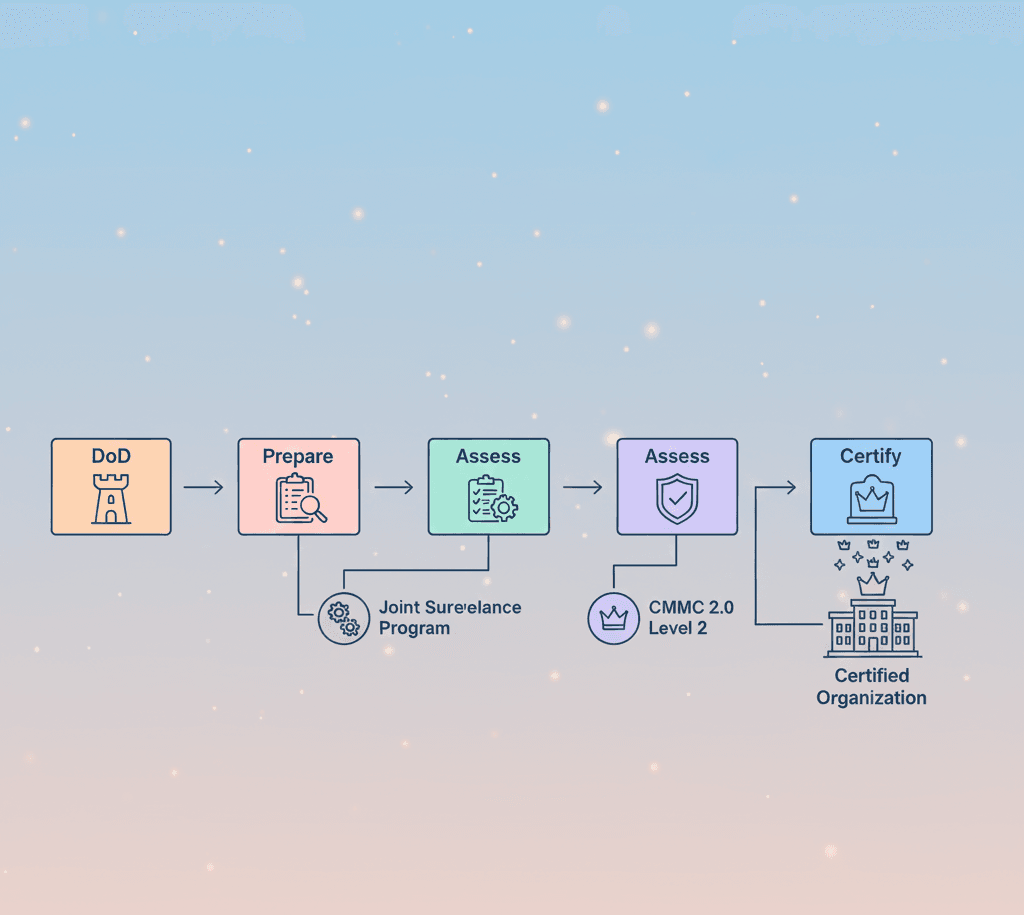
If your business handles CUI, Level 2 certification is likely your target. Here’s how to move forward if you're wondering how to get CMMC certified:
Identify whether you handle CUI or FCI
Use our NIST 171 checklist to benchmark your current controls
Map your security controls using Accorp’s tools and policies
Prepare for third-party or government assessments
Continuously monitor and update your policies and procedures
Conclusion
As cyber threats evolve, so must your defences. CMMC compliance isn’t just about meeting regulations—it’s about protecting your organisation and the nation's security interests.
With Accorp’s CMMC cybersecurity compliance services, including tailored assessments and ongoing support, you can automate, simplify, and accelerate your path to CMMC certification. Whether you're handling FCI, CUI, or both, our tools and services are designed to guide you through every phase of compliance with confidence.